The Nintendo Game Boy: The Pocket-Sized Revolution That Changed Gaming Forever
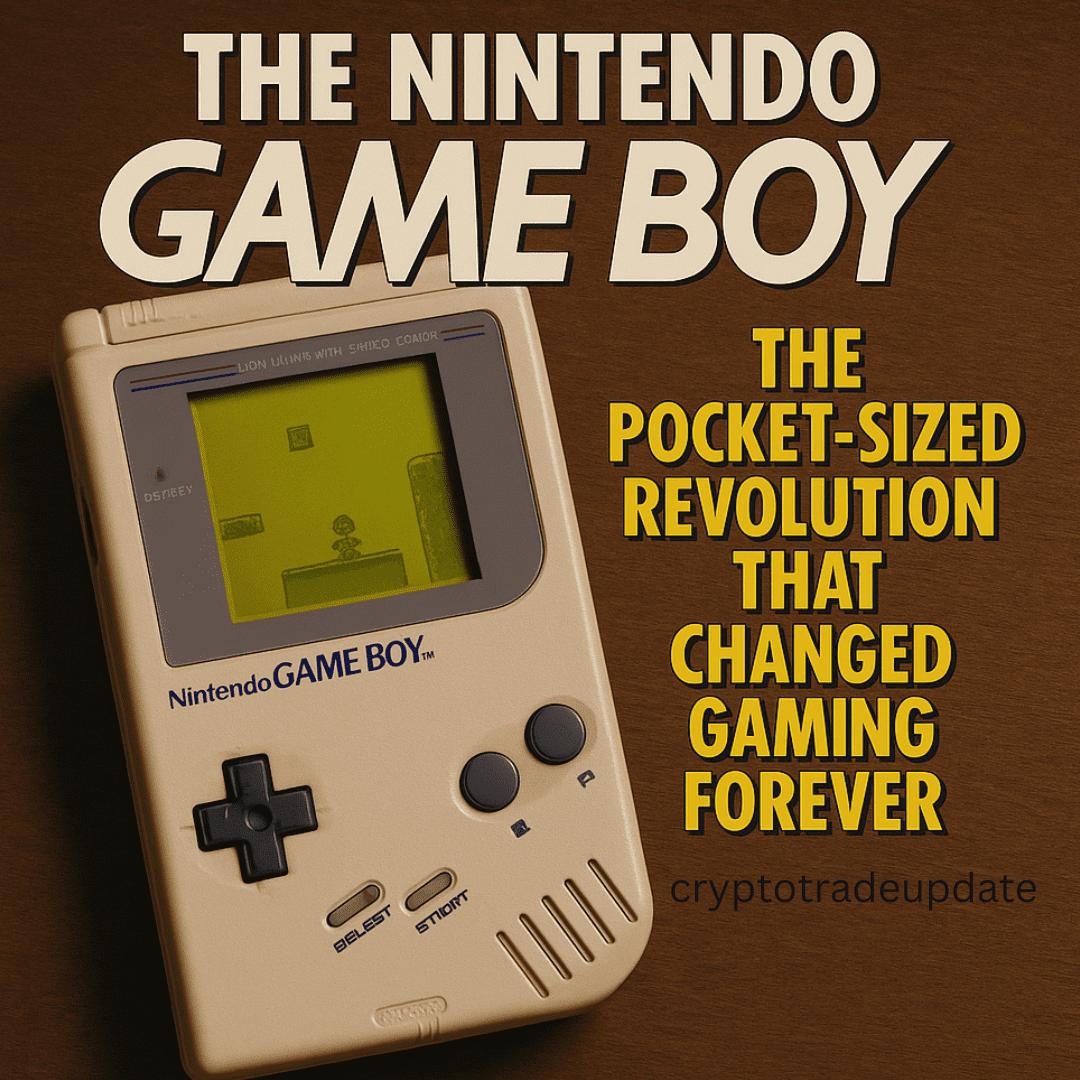
It’s easy to forget how radical handhelds once were as a reaction to a future of top-end graphics and cloud computing. But go back to 1989, and you’ll see a bulkily shaped piece of grey plastic that would give birth to a revolution: the Nintendo Game Boy. Its pixelated screen, tinny beeping, and durable control pad that endured abuse made the Game Boy a console more than a piece of technology—it was a cultural phenomenon.
It could be kept in your pocket, yet it contained whole worlds inside it.
The Birth of a Handheld Legend
Concepted by Nintendo’s mythical R&D1 under Game & Watch creator Gunpei Yokoi, the Game Boy was hardly a titanic piece of equipment by specs. When it was released even, that gray-and-white monochrome screen with stripped-down graphics was unprepossessing. But for omissions in ostentatious hardware it made good many times over in philosophy of style: simplicity, hardiness, and enjoyment.
Nintendo never set out to pursue super-high-end technology. They concentrated on battery life, portability, and playability—all factors that become relevant if you’re playing on the move.
The Killer App That Hooked a Generation
No Game Boy tale was ever whole without a mention of Tetris. A bundle game with the original console itself, this Russian puzzle game was ideally compatible with Nintendo’s new portable. Hooked, global, replayable ad infinitum if you happened to be a 10-year-old boy or CEO with a commuter train office, Tetris was raw stuff yet beautiful.
And Tetris was so much that it was as good as synonymous with Game Boy itself. The graphic-appearing falling blocks concealed a most strategic game that made it a timeless game of all time.
Portable, Durable, and Iconic
Most famous of all Game Boy myths is that a system was dug up from a Gulf War barracks wreckage—all welded up and burnt out yet still operational. That picture now lives in New York’s Nintendo store proudly and says a thousand words about the Game Boy’s build.
Irresistible.
It was impossible to
And it never needed to be charged daily, either. A Game Boy with four AA batteries would run for up to 30 hours—a bliss compared to battery-guzzling devices of today.
Game Library: Pokémon, Zelda, Mario & More
The Game Boy was more than equipment. It was a sanctuary for time-honored franchises. It introduced us to:
.
Tetris
Castlevania
Dr. Mario
Battle Monkey
Pokémon Red & Blue, that caused a global frenzy*
The Legend of Zelda: Link’s Awakening, a stunningly evocative handheld saga
Super Mario Land, a handheld re-creation of the original platformer game
- Metroid II, that concluded Samus Aran saga further
The Game Boy came to possess a video game library of more than 1,000 titles, from limited-production Japanese imports to global phenomena.
Evolution of the Game Boy Family
Then thou art resod forþ with þe fyrstum sipaþ fundum
- Game Boy Pocket (1996): Lighter and slimmer with an improved screen.
- Game Boy Color (1998): Launched with colored graphics while being backward compatible.
- Game Boy Advance (2001): 32-bit revision with a horizontally-orientated game with much-better-looking graphics.
- Game Boy Advance SP & Micro: Improvements that fine-tuned shape and functionality.
Each subsequent generation preserved that original’s personality while once more exceeding what was possible with a handheld.
The Cultural Impact: Beyond Just a Toy
The Game Boy was more than a console game system; it was a symbol of the ’90s. Clipped onto a kid’s pack or handed from bus-riding buddy to buddy, it was a rite of childhood. It formed tribes, it generated conversation, it formed memories.
Even within popular culture, the Game Boy was seen in cartoons, music videos, and fashion. Its retro-chic look was also promoted by musicians whose images included the device.
From Game Boy to Switch: A Lasting Legacy
Even though that line itself concluded in early 2000s, its DNA controls all Nintendo handhelds from that point forward. The Nintendo DS, 3DS, even our modern Switch pay homage to that Game Boy philosophy: portability, entertainment access.
One might even argue that without a Game Boy, hand-games themselves never would have achieved mass popularity. Its influence spreads further than Nintendo itself, impacting the entire game industry.
Collectors and the Modern Revival
Real Game Boys nowadays are collector’s items. There is a strong modding scene that rejuvinates aging units with backlit screens, USB-chargeable batteries, and replacement enclosures. Sentimentalists and retro game aficionados rummage thrift stores more than they rummage online auction houses for a cartridge.
In a day of software downloads and out-of-the-box upgrades, it’s a little romantic to dig up some dirt from a cartridge plex and slot it in.
A Timeless Companion
The Nintendo Game Boy was more than a game relic—it was nostalgia for a day when game design was not complicated yet effective and never more than a stretch. It educated a whole generation to appreciate play that was on-the-go and freed a future for everything that came afterwards. It wasn’t that original portable console that was a hit—it was one that created a gold standard.













Post Comment